
You Are the River
On purpose, meaning, and why we keep confusing the two.

Sometimes I struggle to accept that I can’t write my why on a t-shirt and wear it with pride. I watch others do it — people and companies — and I want what they seem to have: the clarity, the confidence, the clean sentence that says it all. Not that I haven’t tried. I’ve sat in the workshops, filled the canvases, facilitated the exercises myself. And every time I ended up with words that felt more like a costume than a skin.
For a long time, I thought the problem was me.
Then I went to the river.
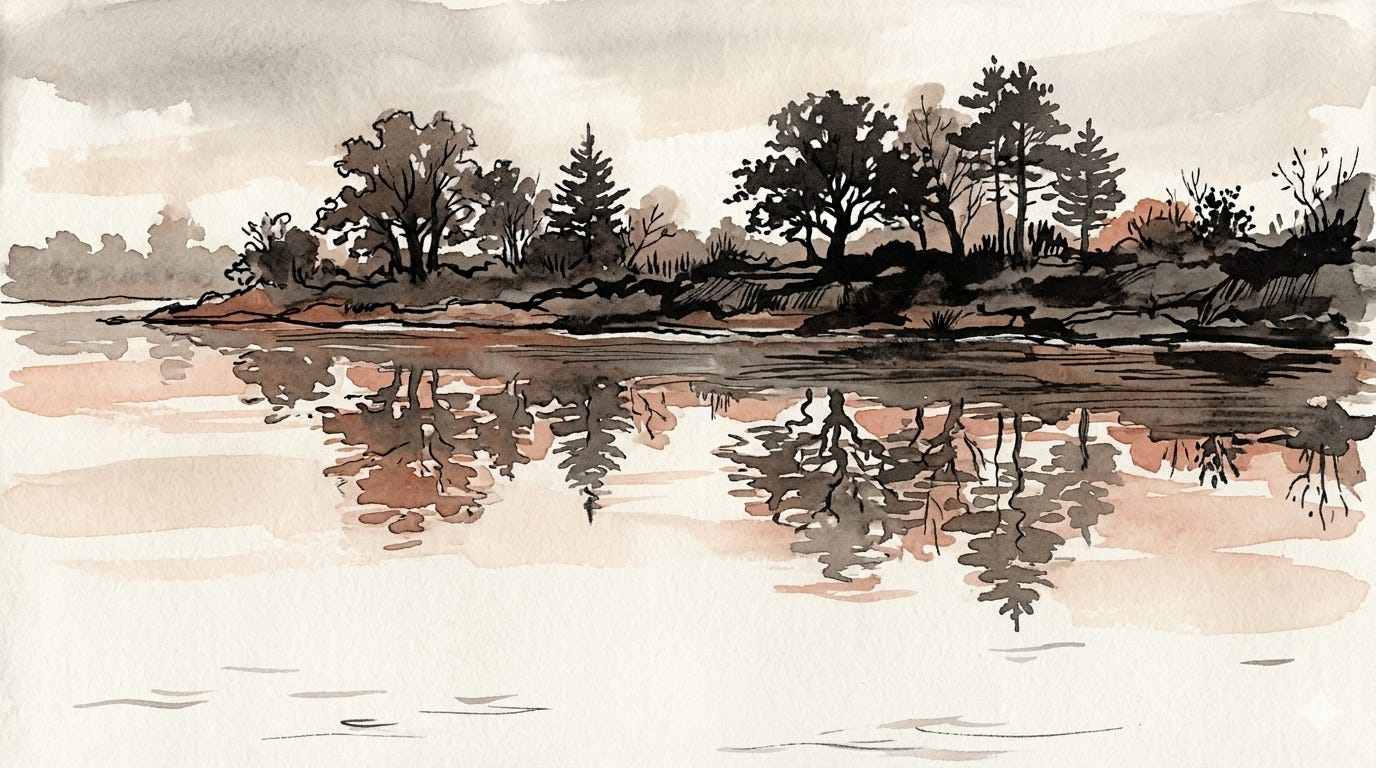
February 2023. I was walking in silence along the Narmada with a small group of men. It was a day of fasting and quiet, free from everything non-essential. I was doing what I always do in silence: paying attention to what’s around me to still what’s inside me. The river was moving slowly and beautifully, with no apparent effort, toward the ocean.
And then, out of nowhere, a few words appeared in my mind.
One day, I’ll find my river.
I wrote them down and spent the rest of the journey turning them over. By the end, I welcomed them as both invitation and promise: keep going, something is waiting.
A year later, I was back. Same river, different group of men, same silence. Watching the Narmada again. Words arriving again without warning, from somewhere beyond thought.
I am the river.
I had to stop walking. The promise had kept itself, but not in the way I expected. I hadn’t found something external. I had recognized something I already was.

The river is not a metaphor for finding your purpose. If anything, it’s something closer to the opposite.
The river doesn’t have a purpose it chose, crafted, or needs to defend. It doesn’t know its why. It simply is what it is, fully, in every moment. That fullness is its purpose. The flowing is the meaning. There’s no separation between what the river is and why it exists.
In my book Subtraction, I wrote about what I called intentioning — not the conscious process of setting intentions, but the unconscious process of being intended upon. You’re not deciding your purpose: you’re being drawn toward it. It’s not an invention. It’s recognition.
This is a completely different grammar. And I think it’s why the standard approach to purpose — find it, name it, align with it — so often produces exhaustion and confusion rather than clarity. We try to manufacture from the outside what can only be received from within. Or more precisely, what can only be lived into.
Viktor Frankl, who explored meaning more deeply than most, put it simply: we don’t invent meaning, we detect it. It’s already there, woven into the unique texture of a unique life. You don’t construct it. You recognize it — often in retrospect, often in silence, sometimes beside a river.
After reading Daniel Pink’s Drive, which places purpose at the center of motivation at work, I delved deeper into the research Pink built on: Self-Determination Theory, by Edward Deci and Richard Ryan, one of the most robust frameworks in psychology for understanding what actually drives people.
To my surprise, I didn’t find purpose as a core ingredient.
What I found instead were three things: autonomy, competence, and relatedness. The sense that your actions come genuinely from you. The satisfaction of growing more capable at something you care about. The feeling of genuine connection with the people around you.
What struck me is that all three are about who you are, not what you’re for. They describe a way of being in the world — present, growing, connected — rather than a destination to aim at. Purpose, in this framework, isn’t the fuel. It’s the byproduct. It’s what a life oriented around those three things produces naturally, quietly, without needing to be announced.
I think of a man I met at a wedding more than thirty years ago. I was still a student; he was a family man. By chance, we were sitting next to each other, and at some point, he told me he had left a prestigious role at a company to become a postman. So he could be home more. So he could spend more time with his son, who needed his support.
He wasn’t aligning with a mission statement. He wasn’t performing a purpose. He simply knew what mattered — his son, his presence, his time — and he organized everything else, including work, around that. His meaning was so specific, so personal, so utterly his own that no organization could have given it to him or taken it away. His purpose was not in his job. It was in him.
That’s the kind of purpose I believe in. Not the kind you craft. The kind you are.
The problem with the prevailing approach to purpose isn’t that it cares too much about meaning. It’s that it misunderstands what meaning is.
Purpose gets treated as something you have — a possession, a position, a statement — and therefore something that can be given, shared, co-created in a workshop, printed on the wall. But if purpose is something you are, then the whole project is confused from the start. You can’t give someone what they already are. And when you try — when you stand on a stage and tell people what their why is or should be — you don’t illuminate their purpose. You crowd it out.
Frankl called meaning a sanctuary. The one thing that cannot be taken away, even in the most extreme circumstances, because it lives in the interior of a person, in how they meet whatever is in front of them. When an organization tries to colonize that sanctuary — even with the best intentions, even through “co-creation” — it violates something. It turns a sacred private process into a management instrument.
I know, because I’ve been inside that machine. I’ve run the workshops. And I’ve felt the particular discomfort of sitting across from someone and essentially asking them to make their inner life useful to an institution.
So what do we do instead?
I want to be careful here, because I’m not interested in offering another framework to replace the one I’m questioning. That would be hypocritical. But I do think there’s something freeing in what both the research and the river point toward.
You may not need a purpose statement. You need to pay attention to three much simpler things.
How much of what you do comes genuinely from you — from your values, your intuitions, your sense of what matters — rather than from pressure or expectation? That integrity, that alignment between inner and outer, is what autonomy actually means.
Are you growing? Are you moving, however slowly, toward greater mastery of something you care about? Sarah Lewis wrote that mastery is not a commitment to a goal but to a curved-line, constant pursuit — always approaching, never quite arriving. That pursuit is itself a form of meaning.
And who are you doing this with, and for? The research is clear: relatedness is not a soft add-on to motivation. It’s one of its foundations. The “who” often matters more than the “why.” Our meaning is almost always entangled with someone else’s.
Live inside those three things, and purpose tends to take care of itself. Not loudly. Not in a way that’s easy to put on a t-shirt. But it’s there, woven into the fabric of the days, in the choices you make and the people you stay close to and the craft you keep returning to.
And perhaps this is where organizations have the most to reconsider. Not whether their purpose statement is well-crafted, but whether the whole premise is right. When a company tries to give people a purpose they are expected to embrace and make their own, it turns — despite the best intentions — a profound existential freedom into a management chore.
Meaning does not belong to the organization. It belongs to the individual.
What if we don’t need to share the same why to work well together? What if the real work is not alignment around a single purpose, but mutual respect for the different meanings people bring — and the intelligence to organize work so those meanings can coexist and even support each other? Someone whose deepest meaning lives outside their job entirely — in a child, in a craft, in a community — can still give their best at work, as long as they have genuine autonomy, room to grow, and relationships worth having. That’s not a compromise. That’s a healthy contract. And it might be more honest, and more durable, than any shared purpose statement.
I confess that sometimes I still feel the struggle of not being able to express my why with clarity. It would be so much simpler. Some days that struggle is quieter, some days louder. I don’t think it will ever disappear entirely — and maybe it shouldn’t. Maybe the discomfort is part of what keeps me honest, keeps me moving, keeps me from mistaking a good sentence for the thing itself.
But when I stop, and surrender, and go back to the river, the question dissolves. Not because it’s answered. But because, for a moment, I’m no longer standing outside the river, trying to describe it.
I am the river.
Thanks for reading this far. Muchness is where I explore questions that won’t leave me alone. If that sounds like your kind of thing, subscribe. And if this piece resonates with you, support this journey with a like or by sharing it with those who, like us, are trying to make sense of their reality.
Really wonderful and wise article Fabio. Seems to me your Y is 2 B U
Love this Fabio!🙏
"The river doesn’t have a purpose it chose, crafted, or needs to defend. It doesn’t know its why. It simply is what it is, fully, in every moment. That fullness is its purpose. The flowing is the meaning."
The moment we try to define it,
we step slightly outside of something that can only be lived from within