
What’s Your Story?

There is a question I have been carrying for most of my adult life.
Who am I?
It’s a tiny question yet so evasive. Over the years, I went through many answers. None ever felt satisfying. Whatever I managed to say always felt smaller than what I was leaving out.
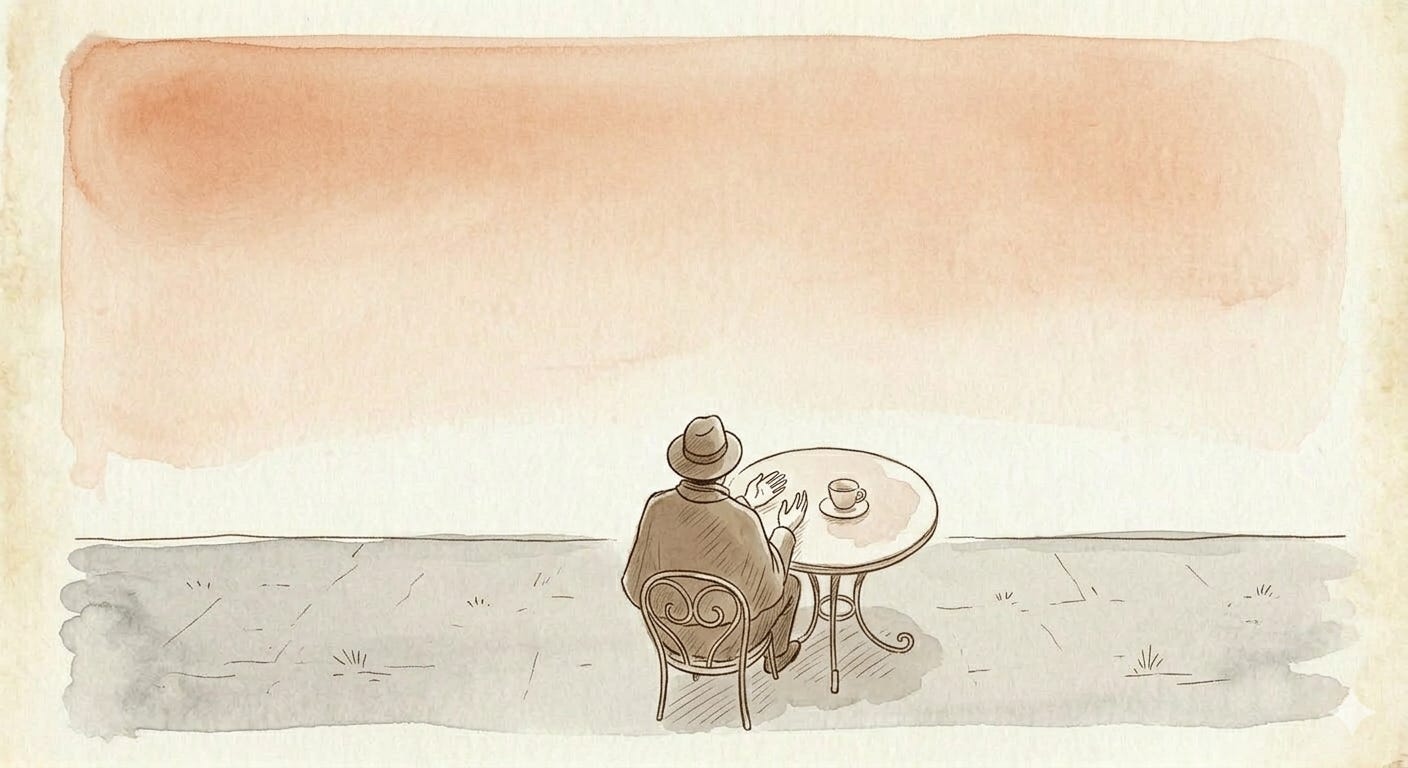
Then one day, I gave up. I still remember the moment. I was sitting in a café in Valencia with an American pastor I had met. We went out for coffee to get to know each other. Two aliens in a Spanish city. And there it came, that tricky question: Who are you?
I didn’t reply. At that time, I was in between. I was nowhere. I had left a career I had held for years, without a clear idea of what was next. Moved to a new country, with no plans. In that moment, I realized I had never really had an answer. The things I used to say — my work, my place, my projects — were just escape tricks. Proxies to fill a gap.
I replied, “I don’t know.”
And the biggest surprise was that, after a brief disorientation, I felt a sense of relief. As if I had quietly removed a weight.
I understand now why that question felt so impossible. Who am I points at something fixed — a picture of yourself that, the moment you take it, is already old. Any answer will always be incomplete, already a step behind whoever you are becoming.
So I needed a new question. I found it a few years later, when a friend shared a line from Aristotle — we become just by doing just acts, temperate by doing temperate acts, brave by doing brave acts.
There it was. Identity is not a state you arrive at and then defend. It’s a movement. Which led me to a better question: not "Who am I?" but "Who am I becoming?"
A question that points at the movement itself. Observable. Ongoing. Liveable.
But it was a third question that made something practical possible. Another friend shared a line from Margaret Atwood: in the end, we’ll all become stories. And that small shift — from becoming to story — unlocked something new. Because a story isn’t just a direction. It’s a pattern with a protagonist, choices, moments that change the trajectory. A before and after.
And a story has an author.
That’s the insight I was looking for. A way to transform a question into a quest. We tend to think of ourselves as protagonists — the main character, at the center of our lives. But if you’re just the protagonist, however central, you’re still a puppet. Your story is written somewhere else, by someone else. You react, you suffer, you triumph — but you don’t choose the direction.
That was my realization. I’m not just the protagonist. I’m one of the authors.
Sure, there are parts I don’t and can’t write. Threads woven by someone or something else. Life isn’t a blank page, and I don’t own the full script. It’s more like improv: things happen that I didn’t script, other actors surprise me, the stage changes without warning. But I choose how to respond. And those responses, accumulated over time, are what shape the story I am becoming.
So the question isn’t just, "What story am I becoming?" It’s: what story do I want to become? And what am I doing today to write it?
Your Story
This is a practice I designed for myself. Two phases. The first is about reading the story you’ve been writing. The second is about choosing the story you want to write.
Grab a pen and paper. There is an intelligence in our fingers that a keyboard can’t reach.
Phase one: read your story
You can’t co-author something you haven’t read. So start there.
What are the defining moments of your story so far?
Think of the moments with a clear before and after. The ones that changed you — not necessarily the dramatic ones, but the ones where something shifted. Who you were before that moment and who you became after it are meaningfully different. You might find two or three. You might find ten. Write them down. And for each one, try to name the change: from what, to what.
When you’re done, look at the title. If your life so far were a book or a movie, what would it be called? Don’t overthink it. The first answer that comes is usually the honest one.
What pattern do those moments reveal?
Look at what you’ve written. What do those moments have in common? What themes keep returning? If you connect the dots — not the dots you wish were there, but the ones that actually are — where is that story going? Who is the protagonist becoming?
What is this story based on?
Every story rests on assumptions — things that have to be true for it to make sense. What does your story take for granted? What does it make possible? And what does it make impossible, or pointless, or not worth attempting?
Now, the question that makes the first three worth asking:
Is this the story you want to become?
If the answer is a full yes, your choices today are already aligned. Keep writing.
If it isn’t — if there’s a gap between the story unfolding and the story you want — then it’s time to pick up the pen. Again.
Phase two: write the story you want
Now shift your perspective. Stop looking at yourself and look at the person you want to become — as if they were a character you’re about to write. Someone you know well, but haven’t fully met yet.
What kind of person is this?
How do they act? How do they make decisions? How do they relate to others? What do they care about, and what have they let go of? Write them as you would write a character you admire.
What is their story based on?
What does this person believe to be true — about themselves, about others, about what’s possible? What does their story make possible that yours currently doesn’t?
What would this person do today?
Not a plan. Not a transformation. One thing, small and concrete, that belongs to their story rather than the one you’ve been writing by default.
That person is you. The protagonist.
But you’re also the author who gets to decide when the next chapter begins.
So, what story are you becoming, today?
Thanks for reading this far. Muchness is where I explore questions that won’t leave me alone. If that sounds like your kind of thing, subscribe. And if this piece resonates with you, support this journey with a like or by sharing it with those who, like us, are trying to make sense of their reality.