
Finding Your Place: A Framework for Professional Inclinations

Have you ever felt like a square peg being forced into a round hole at work? Or watched a colleague struggle in a role that seems to drain their energy daily? We've all encountered that nagging feeling that something just isn't quite right with our professional fit.
I wonder if that's because many of us are operating in roles that conflict with our natural inclinations. We're told to "lead more," "be more creative," or "just execute the plan" without considering whether these directives align with our authentic selves.
A Draft Framework to Start a Conversation
This framework emerged from a personal revelation during a conversation with a dear friend. We both shared a common struggle – we wanted to lead meaningful professional lives but didn't have a singular, crystal-clear vision like many entrepreneurs we knew. We weren't content simply following others' directions either. Where did we fit?
This question led me to sketch out this simple framework – not as a definitive model, but as a starting point for reflection and conversation about how we might understand our natural tendencies.
The framework consists of two fundamental dimensions:
Vision-Driven vs. Support-Driven (What primarily drives you)
Vision-Driven: You're primarily motivated by bringing your own ideas and direction to life
Support-Driven: You're primarily driven by the desire to help others realize their visions
Self-Directing vs. Direction-Following (How you navigate your path)
Self-Directing: You prefer to chart your own course and take charge
Direction-Following: You contribute best within established frameworks
It's worth noting that these dimensions aren't always clear-cut. Many of us have elements of both ends of each spectrum, and our positioning can shift based on context. You might be simultaneously driven by your own vision and by helping others in different areas of your life, or you might self-direct in some contexts while preferring established frameworks in others. This framework is simply a tool to help identify dominant patterns and preferences.
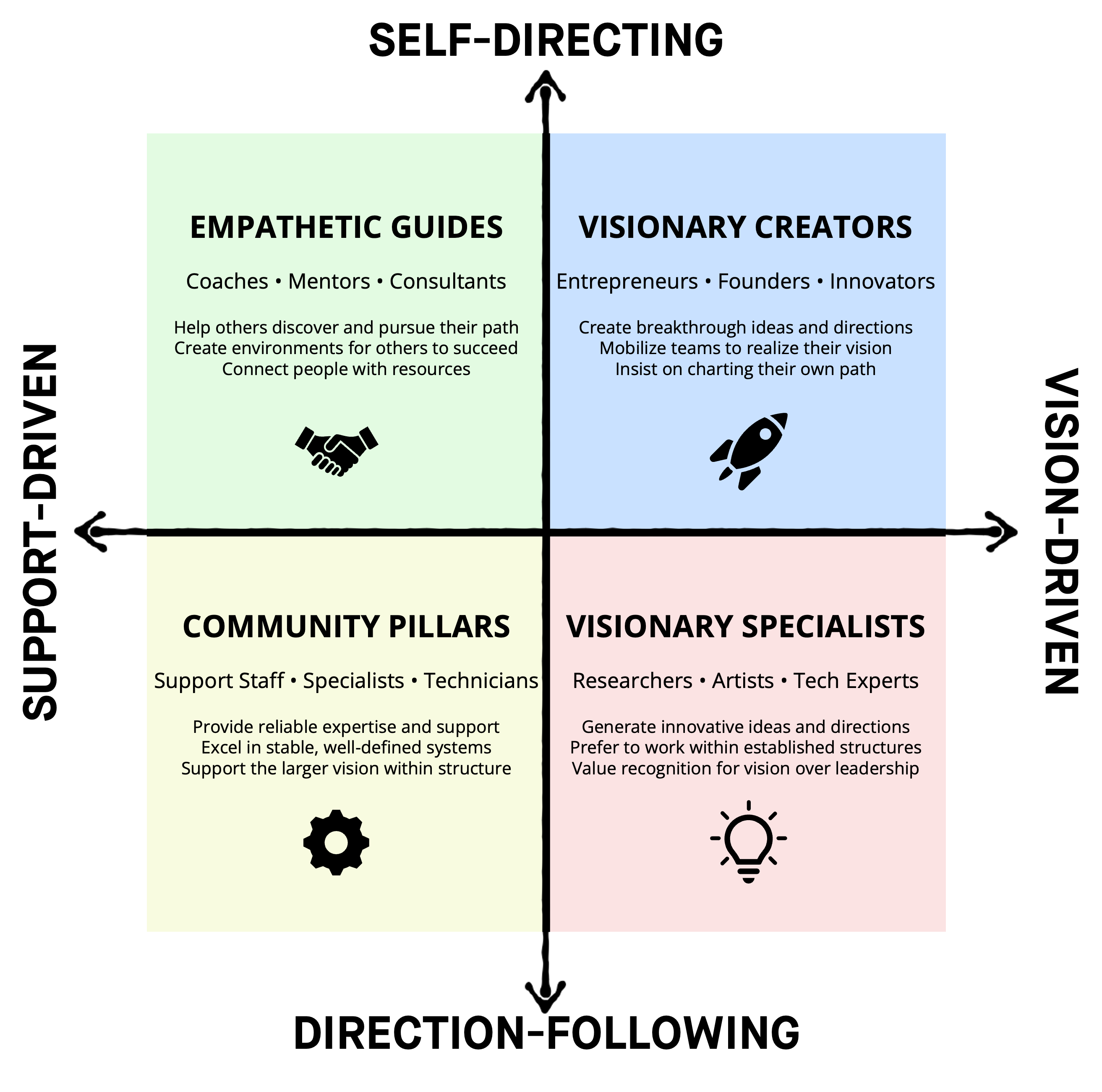
When we combine these dimensions, we get four distinct professional archetypes:
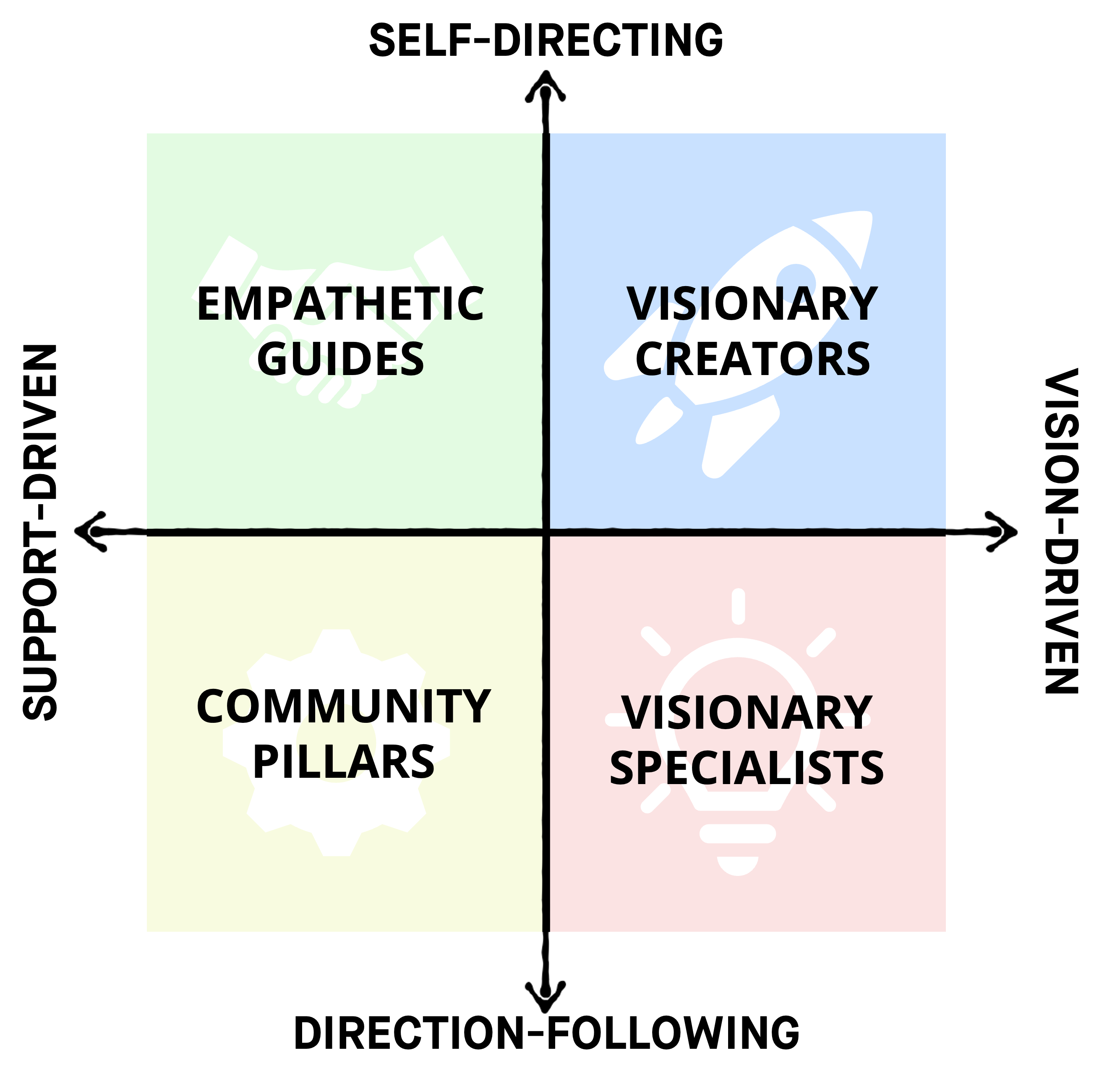
1. Visionary Creators (Vision-Driven + Self-Directing)
These are the founders, entrepreneurs, and innovators who not only generate breakthrough ideas but also rally teams to bring them to life. They know where they want to go and insist on charting their own path to get there.
Think of Steve Jobs building Apple or Sara Blakely creating Spanx – they saw possibilities others didn't and were determined to lead the journey themselves.
Visionary Creators thrive when:
Building something new from scratch
Setting direction for a team or organization
Having the autonomy to pursue their vision
Challenging the status quo
They struggle when:
Forced to implement others' ideas
Bogged down in routine execution
Required to follow rigid protocols
Deprived of creative control
2. Visionary Specialists (Vision-Driven + Direction-Following)
These individuals have innovative ideas and clear direction but prefer to work within established structures rather than lead the charge themselves. They're often the brilliant minds behind successful products who don't seek the spotlight.
Steve Wozniak, who co-founded Apple but was content to let Jobs be the face of the company, exemplifies this quadrant. Many researchers, inventors, and artists also fit here.
Visionary Specialists thrive when:
Given space to pursue their vision within a structured environment
Paired with leaders who value and implement their ideas
Focused on creation rather than management
Having their direction respected without leadership burdens
They struggle when:
Forced into leadership positions
Expected to handle administrative burdens
Required to motivate and manage others
Judged on leadership rather than their vision and expertise
3. Empathetic Guides (Support-Driven + Self-Directing)
These people excel at helping others realize their potential and vision. They may not generate the original direction, but they know how to help others find their path and remove obstacles along the way.
Coaches, mentors, consultants, and many successful executives fall into this category. Their gift lies in their ability to connect deeply with others while maintaining their own independence and leadership.
Empathetic Guides thrive when:
Helping others discover and pursue their path
Building environments where others can succeed
Connecting people with resources and opportunities
Leading supportive initiatives and teams
They struggle when:
Expected to be the source of the primary vision
Unable to help others grow and develop
Working in isolation from people
Judged primarily on personal output rather than their impact on others
4. Community Pillars (Support-Driven + Direction-Following)
These individuals excel at supporting projects and people within established frameworks. They're the backbone of any successful organization – reliable, skilled, and focused on contributing to the larger vision.
Community Pillars thrive when:
Given clear direction and expectations
Able to support others in a structured environment
Working within stable, well-defined systems
Recognized for reliability and supportive contributions
They struggle when:
Pushed to create original visions
Expected to lead without training or interest
Faced with constant change and ambiguity
Pressured to take on roles outside their supportive expertise
The Problem of Misalignment
When people operate outside their natural inclinations for extended periods, the consequences can be severe:
Burnout: Constantly working against your nature depletes mental and emotional resources
Impostor Syndrome: Feeling inadequate because you're being evaluated on qualities that don't align with your strengths
Reduced Performance: Even the most talented people underperform when miscast
Diminished Wellbeing: The stress of misalignment often spills into personal life
I remember when, in my first job, I was promoted to team leader because I was doing well as a software developer. At that time of my career and in that context, I was more of a natural Visionary Specialist. That promotion made me uncomfortable and insecure. I started questioning my abilities, my creativity dried out, and I became stressed out.
A few years ago, I was under self-generated pressure because I didn't have a clear vision. Then, I came across coaching and mentoring and found new energy. I fully embraced my Empathetic Guide inclination, and now I feel like I'm living multiple lives at once by supporting individuals and organizations to refine and realize their visions.
The Contextual Nature of Inclinations
It's important to recognize that these inclinations aren't rigid boxes but contextual tendencies that can shift based on the following:
The specific project or situation: You might be a Visionary Creator in your personal passion project but a Community Pillar in your day job.
Your stage of life or career: Early in your career, you might operate as a Visionary Specialist, but as you gain experience, you might develop into an Empathetic Guide helping others develop their visions.
The team composition around you: Your natural inclinations might express differently depending on the gaps and needs in your team.
Your level of interest in the subject matter: You're more likely to step into a vision-driven role in areas that deeply engage you, while taking a more supportive role in areas where you have less passion.
This flexibility doesn't invalidate the framework – instead, it makes it more useful. Understanding your contextual inclinations helps you recognize when you're operating in or out of alignment and make conscious choices rather than defaulting to expectations.
Finding Your Alignment
The goal isn't to label yourself permanently but to develop self-awareness that guides better career choices. Here's how to use this framework effectively:
Reflect on when you've felt most energized at work: Which quadrant were you operating in during these peak experiences?
Notice when you feel drained: Are you being asked to create a vision when you prefer to support others, or to self-direct when you prefer structure?
Consider contextual variations: Do your inclinations shift based on the subject matter, team, or setting?
Experiment with different roles: Test whether a new position better aligns with your natural tendencies.
Communicate your insights: Share your reflections with managers or mentors who can help position you for success.
The most successful professionals aren't necessarily those who force themselves to excel in all quadrants, but those who understand their natural inclinations and find environments where those strengths are valued.
Embracing Your Place in the Professional Ecosystem
Every quadrant is essential in a thriving organization or ecosystem. Visionary Creators need Visionary Specialists to enhance their ideas, Empathetic Guides to help people develop, and Community Pillars to provide reliable support.
A vision requires all types of people to become reality. Visionaries alone cannot bring their ideas to fruition – they need those who share and enhance the vision, those who can guide and nurture others along the way, and those who reliably support the community's efforts.
The Human Advantage in the Age of AI
Interestingly, as artificial intelligence becomes more integrated into our professional lives, this framework raises questions about uniquely human capabilities. Current AI systems seem to excel primarily in the Community Pillar quadrant – reliably executing defined tasks within established frameworks. They have no intrinsic vision or direction of their own, and while they can simulate support, they may lack the genuine empathy that makes human support so valuable.
The other quadrants appear to require fundamentally human capacities:
Vision: The ability to imagine what doesn't yet exist
Empathy: The capacity to truly understand and connect with others
Self-direction: The initiative to chart a meaningful course through uncertainty
This doesn't mean AI won't transform work – it's already doing it. But reflecting on our distinctly human strengths becomes even more critical in navigating this future.
Starting the Conversation
This framework isn't meant to be definitive or prescriptive. Instead, it's an invitation to reflect on your own inclinations and discuss them with others. Some questions to consider:
Where do you find yourself most naturally drawn in this framework?
Have you been trying to force yourself into a quadrant that doesn't align with your natural tendencies?
How might understanding these inclinations help teams work more effectively together?
What quadrant do you naturally gravitate toward? And more importantly – is your current role allowing you to work from that place of strength?
I'd love to hear your thoughts and experiences with this framework. Where do you see yourself, and has this sparked any insights about your professional journey?